
How Many Inches in 1 Foot? Exact Answer, Formula & Chart
Quick Answer
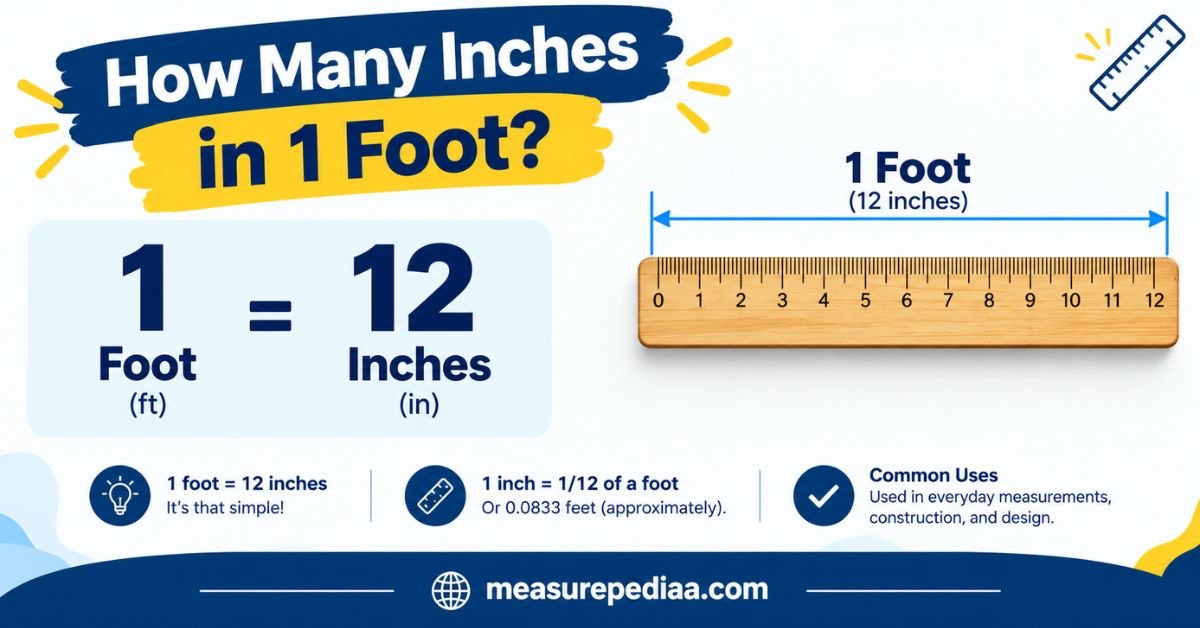
There are exactly 12 inches in 1 foot. This is a defined relationship, not a rounded estimate, so it holds for every length. To convert feet to inches, multiply by 12. For example, 1 foot × 12 = 12 inches. Both units belong to the US customary system and are defined exactly in terms of the metric system: 1 foot equals 0.3048 meters and 1 inch equals 2.54 centimeters.
The rest of this article covers the formula, charts, the metric equivalents, real-world comparisons, and the mistakes people most often make with this conversion.
The Feet-to-Inches Formula
The conversion is a single multiplication:
inches = feet × 12
To go the other way, divide:
feet = inches ÷ 12
Here are a few worked examples:
- 3 feet: 3 × 12 = 36 inches
- 7 feet: 7 × 12 = 84 inches
- 2.5 feet: 2.5 × 12 = 30 inches
- 90 inches: 90 ÷ 12 = 7.5 feet
Fractions of a foot work the same way. Half a foot is 0.5 × 12 = 6 inches, and a quarter of a foot is 3 inches. A third of a foot is 4 inches, and three-quarters of a foot is 9 inches.
Feet-to-Inches Conversion Chart
The chart below lists common values. Every result is exact because it comes straight from the multiplication rule.
| Feet (ft) | Inches (in) |
|---|---|
| 1 | 12 |
| 2 | 24 |
| 3 | 36 |
| 4 | 48 |
| 5 | 60 |
| 6 | 72 |
| 7 | 84 |
| 8 | 96 |
| 9 | 108 |
| 10 | 120 |
| 12 | 144 |
| 15 | 180 |
| 20 | 240 |
| 50 | 600 |
| 100 | 1,200 |
To find a value that isn’t listed, add rows together. For 13 feet, add the 10-foot and 3-foot rows: 120 + 36 = 156 inches.
Converting Inches to Feet
Going from inches to feet means dividing by 12. In everyday American usage, the answer is often given as whole feet plus leftover inches rather than as a decimal. For example, a person who is 5 feet 9 inches tall is 69 inches tall.
To convert a number of inches into feet and inches:
- Divide the inches by 12 and keep the whole number. That is the number of feet.
- Take the remainder. That is the number of leftover inches.
For example, take 65 inches. Since 65 ÷ 12 = 5 with a remainder of 5, the answer is 5 feet 5 inches. As a decimal, 65 ÷ 12 is about 5.42 feet.
| Inches (in) | Decimal feet (ft) | Feet and inches |
|---|---|---|
| 6 | 0.5 | 0 ft 6 in |
| 18 | 1.5 | 1 ft 6 in |
| 30 | 2.5 | 2 ft 6 in |
| 48 | 4 | 4 ft 0 in |
| 60 | 5 | 5 ft 0 in |
| 65 | about 5.42 | 5 ft 5 in |
| 72 | 6 | 6 ft 0 in |
| 100 | about 8.33 | 8 ft 4 in |
Decimal feet and feet-and-inches are different notations. A measurement of 5.5 feet means 5 feet 6 inches, not 5 feet 5 inches. This mix-up is one of the most common sources of error in conversions, and it comes up again in the mistakes section below.
What Exactly Is a Foot, and Why Is It 12 Inches?
Today a foot is defined by the metric system. Under the 1959 international agreement, 1 yard equals exactly 0.9144 meters. Since a yard is 3 feet, 1 foot equals exactly 0.3048 meters. Because a foot is 12 inches, 1 inch is exactly 0.3048 ÷ 12 = 0.0254 meters, or 2.54 centimeters.
Historically, the foot is one of the oldest units of length, and its size varied by time and place. Standardizing it took centuries. The division into 12 inches is convenient for the same reason 12 is useful elsewhere: it divides evenly by 2, 3, 4, and 6. A foot splits cleanly into halves (6 inches), thirds (4 inches), quarters (3 inches), and sixths (2 inches), which suited builders and tradespeople. That convenience helps explain why the system lasted, though the exact origins of the 12-inch division are not fully documented.
The US Survey Foot: A Small Footnote
For readers curious about technical details, the United States once had two slightly different feet. The international foot is exactly 0.3048 meters. The older US survey foot, used in land surveying, was defined as 1200/3937 meters, or about 0.3048006 meters.
According to NOAA, the difference amounts to only about one one-hundredth of a foot per mile. NIST and NOAA deprecated the US survey foot as of December 31, 2022, and the international foot is now the standard definition. In everyday use, none of this changes the answer: 1 foot is 12 inches. The distinction matters mainly to surveyors and mapmakers working with older land records.
Foot and Inch in Metric Units
Many readers need metric equivalents, especially for international projects, product specifications, or school assignments. The values below are exact.
| US customary | Metric equivalent |
|---|---|
| 1 inch | 2.54 centimeters (25.4 millimeters) |
| 6 inches | 15.24 centimeters |
| 12 inches (1 foot) | 30.48 centimeters (0.3048 meters) |
| 2 feet | 60.96 centimeters |
| 3 feet (1 yard) | 91.44 centimeters (0.9144 meters) |
Here is a quick check on the calculation. Multiplying 12 inches by 2.54 centimeters per inch gives 30.48 centimeters, which matches the foot-to-centimeter figure.
This is the US foot. Imperial and US customary lengths for the foot and inch are the same in modern use, since both countries adopted the 1959 definitions. The unit differences that most often cause confusion are in volume, such as the US gallon versus the Imperial gallon, not in length.
How Long Is 12 Inches in Real Life?
A foot is easier to remember when you can picture it. These comparisons are approximate.
- A standard ruler. Many school and office rulers are 12 inches long, which makes them a convenient reference for a foot.
- A sheet of letter paper. US letter paper is 11 inches on its long side, so a foot is just a bit longer than the paper’s height.
- Floor tiles. Square tiles measuring 12 by 12 inches are a common size in home improvement, though many other sizes are sold.
- A typical step stool or low shelf. Many household items fall near 12 inches, but sizes vary by product, so check the specifications of any specific item.
For larger distances, a regulation basketball rim is 10 feet (120 inches) above the floor. A standard yard is 3 feet (36 inches), and a mile is 5,280 feet, which is 63,360 inches.
The comparisons above are meant as general reference points. Product sizes vary by manufacturer, so these examples shouldn’t be used as exact specifications for any particular item.
4 Common Mistakes When Converting Feet and Inches
Using 10 instead of 12. Because the metric system is based on tens, some people assume a foot has 10 inches. It does not. The foot-inch relationship is base 12.
Treating decimal feet as feet and inches. A reading of 5.5 feet is 5 feet 6 inches, because 0.5 × 12 = 6. Writing it as “5 feet 5 inches” is incorrect. Likewise, 5.25 feet is 5 feet 3 inches, not 5 feet 25 inches.
Applying 12 to area or volume. The factor 12 only applies to length. For area, you must square it, and for volume, cube it:
- 1 square foot = 12 × 12 = 144 square inches
- 1 cubic foot = 12 × 12 × 12 = 1,728 cubic inches
This matters whenever you convert flooring, paint coverage, or storage capacity. A 10-square-foot area is 1,440 square inches, not 120.
Rounding too early. When you convert inches to decimal feet, keep several decimal places until the final step. For instance, 100 inches is 8.3333… feet, so rounding to 8.3 and converting back gives 99.6 inches, which is off by about 0.4 inches.
Quick Mental Math Tips
You don’t always need a calculator. These shortcuts work well for everyday conversions:
- Multiply by 10, then add double the number. For 7 feet, 7 × 10 = 70, plus 2 × 7 = 14, gives 84 inches. This works because 12 = 10 + 2.
- Use the 12 times table. Knowing 12, 24, 36, 48, and 60 covers most household measurements.
- Split mixed measurements. For 4 feet 7 inches, compute 4 × 12 = 48, then add 7 to get 55 inches.
- Going backward, count out the 12s. For 55 inches, 48 is four 12s with 7 left over, so the answer is 4 feet 7 inches.
Frequently Asked Questions
1: How many inches are in half a foot?
Half a foot is exactly 6 inches. This comes from 0.5 × 12 = 6.
2: How many inches are in 2 feet, 3 feet, and 5 feet?
Two feet equal 24 inches, three feet equal 36 inches, and five feet equal 60 inches. Each is the number of feet multiplied by 12.
3: How many feet are in 100 inches?
A hundred inches equals about 8.33 feet, or exactly 8 feet 4 inches. This follows from 100 ÷ 12 = 8 with a remainder of 4.
4: How many centimeters are in 1 foot?
One foot is exactly 30.48 centimeters. It follows from the definitions of 1 inch as 2.54 centimeters and 1 foot as 12 inches.
5: Is a foot the same in the US and the UK?
For practical purposes today, yes. Both countries use the foot defined by the 1959 international agreement as exactly 0.3048 meters, and both divide it into 12 inches. The older US survey foot differed from it by about two parts per million, and it has been formally retired.
Explore More Continue Reading Our Guide on: Measurepediaa.com
Conclusion
One foot is exactly 12 inches. To convert feet to inches, multiply by 12, and to convert inches to feet, divide by 12. When a result has leftover inches, express it as feet plus inches, and remember that decimal feet and feet-and-inches are different notations. The factor 12 applies to length only: for area use 144 and for volume use 1,728. Keeping these few rules in mind lets you handle nearly any foot-to-inch conversion with confidence.